I am a fat person. There. I’ve said it. Did it shock you?
I’m fat. I’m also tall, fair-skinned, and green-eyed. At the moment, my hair is dark brown, with more and more silver around my face and spreading throughout (and sometimes, there’s purple over the silver bits). I have a strong, pleasant voice, terrible eyesight, straight teeth, long fingers, and high cheekbones. Why is it that none of that matters as much or is as memorable as the fact that I’m fat?
Many people seem to think fat is a dirty word. They’ll dance around it, try to avoid the subject, get embarrassed, and even argue when a fat person refers to herself as fat. I don’t really understand why, but I think it’s tied in with our society’s dysfunctional attitudes about bodies, especially women’s bodies, in general.
Fat isn’t a moral issue. The word in and of itself isn’t an insult. It’s a description. Humans come in lots of varieties—tall, short, brown, pink, slender—and fat—and they’re all equally wonderful.
I didn’t choose to be fat. I did choose to get off the dieting merry-go-round sometime in the mid-’90s because both personal experience and a multitude of medical studies have shown that dieting simply does not work and is not healthy.
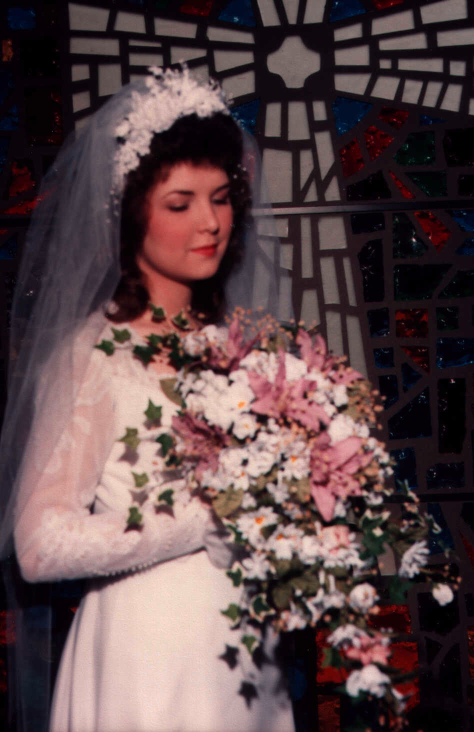
I wasn’t always fat. I only weighed about 120 pounds (a size 6/8 for me) when I was 18, but I remember thinking that I looked like a cow, and couldn’t be attractive until I got rid of those horrible hip and rib bones.1I know the term for that now! It’s Body Dysmorphic Disorder. I didn’t have it anywhere near as bad as some people do, but I certainly had it. (I’ve had people refuse to believe that I was ever that weight, and the photo is posted as proof. It was not a healthy weight for me, but the pictures look good.) It took a serious eating disorder to get to and maintain that weight. I was anemic and constantly light-headed. I passed out with embarrassing frequency. Because I know how much I was able to hide from my friends and family, I don’t find it too surprising that addicts and others with big secrets can also hide a great deal.
I’m much happier with myself and my body now than then, and I know I’m healthier. No, I haven’t managed to fully overcome the anti-fat programming that’s all around me. I still have things to work on. There are days when I don’t like my body when I’m tempted to try again to lose weight. Sizeist remarks still get to me at times—but those times are becoming rarer and rarer.
I hope more and more people start understanding that real beauty is far more than something you can weigh and measure, and I know that it is important to work on bringing that message to everyone. The average size woman in the U.S. is getting taller and larger, according to every statistic I’ve read. Instead of a size six (what dressmakers once claimed was “average”), the true average is more a 14/16 now. Yet the “average” actress gets smaller and smaller, with women like Courteney Cox and Teri Hatcher supposedly wearing size 2 dresses and some even wearing size 0!
Why do most women who are a size 16 believe themselves to be horribly big now? Because today’s press shoves images of women like Hatcher and Cox at us as if they were average—and they’re not. They never have been. They never will be.
There’s a perfectly good reason that my former mother-in-law, who had always worn a size 2, always had a terrible time finding adult clothes in her size. Such tiny people simply aren’t average. They are uncommon.
It’s unhealthy for the great majority of us, whose bodies were never intended to be that small, to attempt to achieve such sizes. The expectation is unrealistic, and the pressure of trying to attain the unattainable is killing too many girls.
There’s something terribly wrong when eighty percent of the ten-year-old girls in our country have already been on a diet. Eating disorders are so common in young women that bulimia isn’t even something to be ashamed of in many middle and high school cliques. The October 1997 issue of Parenting magazine featured an article entitled “Why Even Six-Year-Olds Are Dieting,” It cited studies showing that most girls were “becoming anxious about food and their physiques long before adolescence—as young as age 5 or 6. Their behavior may fall short of clinical anorexia or bulimia, but it shows clear hallmarks of disrupted eating—chronic dieting, obsessing about food and weight, negative body image.” It went on to mention a University of Florida study that found that 42% of the six and seven-year-old girls they studied wanted to be thinner.
Good Girls Don’t Get Fat by body image expert Dr. Robyn Silverman is a fantastic read that I recommend to everyone, fat or otherwise, especially parents. Here’s my detailed review of the book.
Ellyn Satter, R.D., author of How to Get Your Kid to Eat…But Not Too Much2Look, the problem is even demonstrated in the title of the book!, sees a direct connection between the increasing incidence of dieting in preadolescents and obesity in children. She says, “There is a statistical correlation between dieting and fatness. Once you start restricting kids’ intake, they may get frightened and food-preoccupied, and possibly become compulsive eaters, stuffing themselves as if they’re starved.”
Does all this mean that I don’t think anybody should diet or lose weight, or that I have something against people who are naturally thinner than I am? No, of course not. I’m a proponent of Health at Every Size, which is best explained in Lindo Bacon’s excellent book, Health At Every Size: The Surprising Truth About Your Weight. If someone wants to lose weight, that’s his or her business. I do think it’s more effective for people to try to improve their health in general, and sometimes making changes like increasing activity levels and making healthier food choices will result in a weight loss—but it doesn’t result in a weight loss, big or small, for everyone, due to metabolic differences. I don’t go around encouraging people to gain or lose weight—that’s personal. I have nothing against anyone with regard to their looks, no matter how much they may differ from or resemble me in size, height, coloring, etc. I don’t want my children trying to diet their hip bones away, or starving themselves until their metabolism is all screwed up trying to achieve skeletal profiles. I want to encourage greater acceptance of diversity in sizes, just as we’ve started seeing more acceptance of ethnic diversity. Even better, I’d like to see more acceptance of the idea that who you are is more important than what you look like—to achieve a balance that values bodies, minds, and souls together and honors differences.
Dr. Bacon also wrote Body Respect: What Conventional Health Books Get Wrong, Leave Out, and Just Plain Fail to Understand about Weight, which is another wonderful, worthwhile book.
Fortunately, there is growing awareness of this problem and a growing size acceptance movement in the U.S. Groups like NAAFA have been around for years, but mainstream journalists have really paid little attention to these problems until now. Even People Magazine has done an article about eating disorders and how much of the problem is caused by the unrealistically thin models and actresses most often featured on television and in other mass media forums. In fact, they did a second cover article, this one on prominent celebrities who are larger than the norm for Hollywood, like Rosie O’Donnell and Delta Burke.
 I happen to think Camryn Manheim is one of the sexiest public figures around. If a genie appeared and gave me a choice of looking like Manheim or Calista Flockhart, I wouldn’t even have to consider it—I’d pick Camryn. I read Wake Up! I’m Fat! right after it was released, and it was very enjoyable. I’ve read several articles about Camryn recently—my favorite was in Girlfriends Magazine—the photo here is from their cover (hint to magazine publishers: yes, if you put Camryn on the cover of just about anything, I’ll buy it). She’s won an Emmy and a Golden Globe for her role on The Practice, as well as appearing in several movies and stage shows. If you want more of her, Joe Sherlock has gathered just about everything related to Camryn on his website (and also has info about other BBWs in media).