Article from 2001
We considered it part of our responsibility as parents to teach our children certain habits and skills that they need to be independent, responsible adults. Taking care of themselves and their surroundings is important, and they can’t learn without doing. We wanted them to know how to keep house, cook, plan meals, shop for groceries, etc. The only way for them to learn those things was to do them, over and over again until they become second nature.
Also, kids need to know that they are an important part of the household. If someone does everything for them, they don’t learn that. There’s a certain pride in a job well done, in knowing that you’ve contributed something good to your family, that has to be experienced to be understood.
Expectations
As adults, we know how to do many things, and we seldom remember learning to do them. Boil water? Sure. Clean the bedroom? No problem. Iron a blouse? Got it. But we did have to learn how to do those things at some point. In fact, we had to develop separate skills for some tasks—how to dust, vacuum, hang or fold clothing to put it away, how to make a bed in order to clean a bedroom, etc. Most 3-year-olds can be expected to put their toys in the toy box, but they can’t be expected to go clean their bedrooms independently. Some kids can alphabetize a shelf of books at 5, and some can’t.
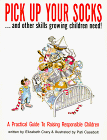
If you aren’t sure as to what you can expect from a child of a certain age, check out the book Pick Up Your Socks…and other skills growing children need!, by Elizabeth Crary. It includes charts of what you can expect from an average child at various ages. I do not agree with everything Crary says (for instance, she seems to see obedience and responsibility as being opposite ends of a spectrum, and I think that it is reasonable to expect both from a child). I found the book very helpful in general, though.
Making your expectations for your kids very clear is important. Making sure that you and any other parents in the household agree on those expectations is essential. If one parent thinks that kids deserve to have everything done for them and the other parent wants the kids to do chores regularly, the adults need to work that out between themselves rather than confusing the children. Once the parents are agreed, they can o present a united, clear front to the kids.
There are tasks that our kids could not do, or couldn’t do without help. Genevieve at age 9 wasn’t strong enough to take the full trash cans out to the street on garbage pick-up day, but she was strong enough to bring the empty cans back down the next day. She wasn’t mature enough to mow the grass or use the weed trimmer, but she was certainly old enough to get the trash and large rocks and sticks out of the yard before it was cut. Katie at age 10 was mature enough to use the weed trimmer, but not quite strong enough for the lawnmower. Rowan at age 12 could do both but wasn’t mature enough to use those tools without supervision. Once a month I moved all the furniture in the house to vacuum under it. That wasn’t something any of the kids could do (okay, Rowan was very close). I also moved all the kitchen appliances that could be moved every month and mopped under them. Again, that wasn’t something the kids could do.
All three kids could, however, help make dinner, clean the kitchen, do their own laundry, clean a bathroom, scoop the catbox, vacuum, dust, etc. We expected them to do those things on a regular basis. We taught them how to do those things and set standards for each task. They certainly weren’t the only people in the house who do those things, but they did take turns at them on a regular basis.
Setting Standards
Sam had a lot of emotional baggage tied up with any kind of cleaning chore. As a child, he’d be told to go clean his room. No matter how hard he tried, though, he couldn’t please his father. Something was always wrong, and his father would get angry, yell, and throw things around. So after a while, Sam would just go into the room, get overwhelmed, move a few things around, and get lost in a comic book. He stopped trying, and as an adult he never expected his own kids to clean anything. Their rooms were absolutely scary. When, at ages 6 and 9, they were finally told “yes, you have to clean your room now,” they had no idea of where to start.
We ended up making detailed lists to help the kids —and Sam. As an example, the clean bedroom standards in our house were as follows:
- Nothing on the floor but the furniture.
- Nothing on the surfaces (tables, etc.) except those things that are supposed to be there (knick knacks, alarm clock, etc.)
- All clothing put away properly (hung neatly or folded neatly in drawers).
- Nothing under the beds or other furniture but the clean carpet.
- Bed looks neat —sheets and pillows in place, blankets folded, etc.
- Books on bookshelf are neat.
- All toys put away properly.
- All surfaces dusted, including tops of pictures. No fingerprints or smears on framed items.
- Floors vacuumed, including under the bed (using the vacuum cleaner hose).
- At least once a month, straighten drawers and closets and discard outgrown clothing and footwear.
We had similar lists for the bathrooms, kitchen, living area, etc. It may seem ridiculous to have to specify all those things, but we didn’t have arguments about whether or not a room was clean after we did so. If we asked "Is your room clean?" the kids knew exactly what we mean. There was no yelling and it didn’t matter if they were talking to me or to Sam. The standards were always the same.
Teaching Skills
Sweeping a floor properly is a skill. Using the vacuum cleaner is a skill. Wiping down a table or counter without just pushing the crumbs onto the floor is a skill. As adults, we take those skills for granted. We can’t expect our children to have such skills unless we consciously model them and patiently teach them to the children. They won’t do things as efficiently or thoroughly as we do at first, and we have to remember that and let them go at their own pace. Yes, it may take your son an hour to clean a bathroom the first time he does it on his own. In time, though, he’ll learn to do it more quickly.
It’s my experience that very small children want to do whatever their parents are doing. They want to help Mommy sweep, wash the car, or fold towels. That’s how they learn. Take advantage of that stage! Give them a broom they can handle and let them try sweeping. Teach them to wash the car, to fold the towels, to measure the flour for making cookies. Be patient —they won’t get it right the first time, and their main interest is being with you and doing "big people stuff." When your daughter makes her very own sandwich absolutely all by herself for the first time, she’ll be bursting with pride. Let her experience that! Later will be time enough to show her how to get the peanut butter and jelly smears off the table, the chair, the floor, and her clothes.
Because we had a blended family, and Sam’s kids were not taught things that way, I had to adjust some expectations about what they should have known, and we went back and did remedial Life Skills 101 with them. Three years into our lives together, they could do most of the things I expecte of them at their respective ages. They needed more supervision and reminders than Katie did because they hadn’t been doing them as long as she had.
Motivation
We tried various ways of helping our kids remember the things they need to do, both for themselves and for the family. As for motivation—well, they didn’t find "hey, the kitchen floor feels gross if it isn’t mopped regularly" to be very compelling. We tied privileges (like watching TV solely for entertainment) to their responsibilities. They didn’t always see the relationship and sometimes whichever child wasn’t permitted to have a certain privilege until he or she finished an assigned task insisted that it was simply unfair. We developed a token system that made the relationship of chores to privileges very clear.
Staying On Track
I really, really hate nagging anybody to do anything. It seems that I was the only person in our household who, in the normal course of a day, noticed that the dishwasher needed to be loaded, run, and unloaded, that a load of towels needed to be washed, or that the living room needed to be vacuumed. If I was the only person who noticed, either I was likely to be the person who did everything or I had to nag other people to take care of needed tasks. I would quickly start getting angry and resentful in that situation. The rest of the household only noticed the lack of clean dishes when they couldn’t find any to use for a meal, or the absence of towels when they needed to take a shower. Since Sam and I did agree that everybody in the house needs to contribute labor towards keeping it liveable, we needed a way to make sure that tasks are assigned fairly and that people remember to do them. Our way of keeping up with tasks involved a system of index cards.